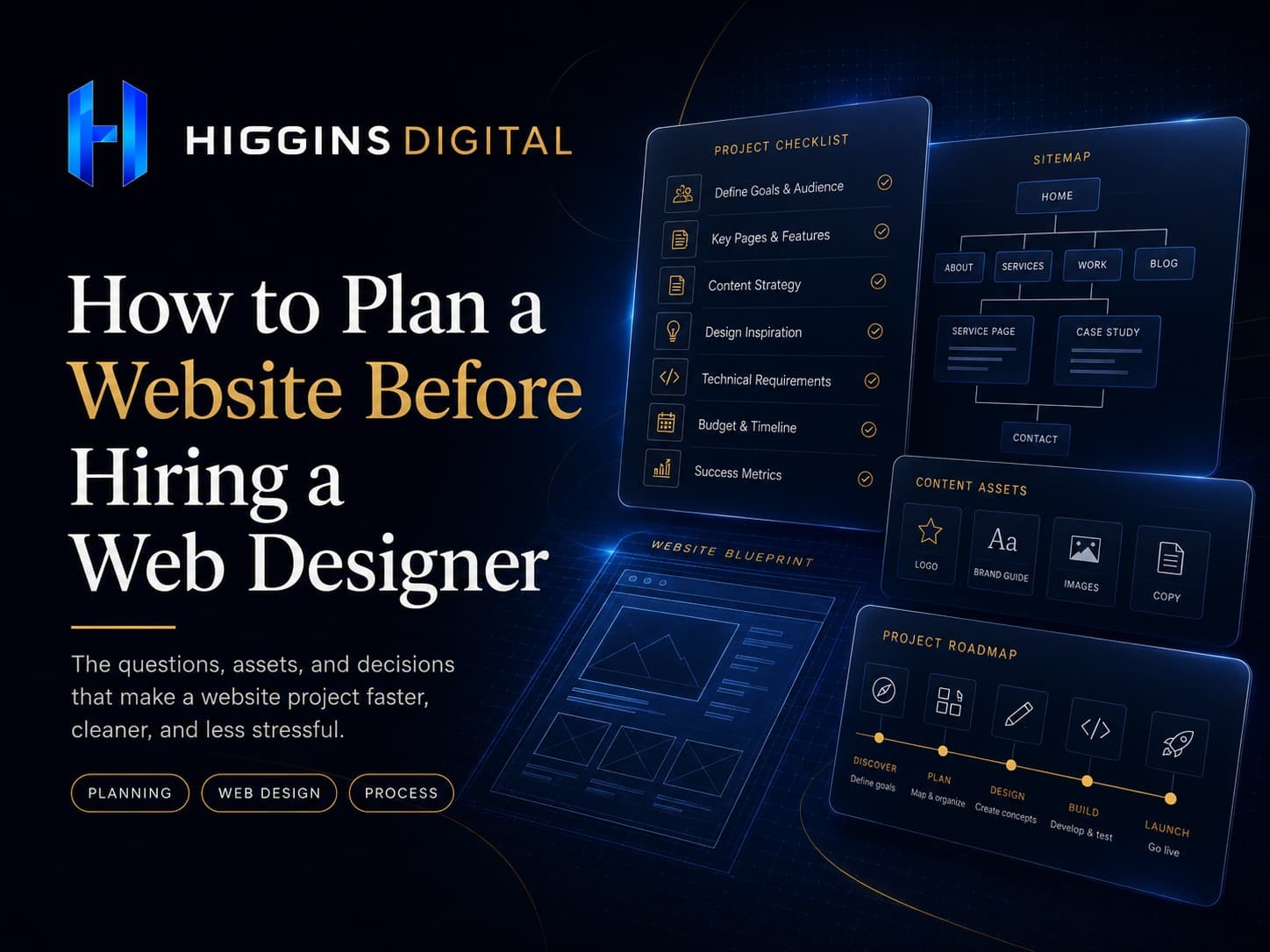
A small-business website does not need every feature. It needs the right information, enough proof to reduce doubt, a clear next action, and a technical foundation that does not work against the customer.
The essential pages
Most service businesses need a focused set:
- a homepage that states what the business does, who it helps, and what to do next;
- service pages with enough detail for a buyer to evaluate fit;
- an About page that identifies the people and point of view behind the work;
- proof through projects, case studies, process detail, or real testimonials when approved;
- a Contact page with a direct route and a usable form;
- required privacy, accessibility, and business disclosures;
- helpful content only where the business can maintain it.
The names can vary, but each page should have a job. Combining everything into one long homepage often makes services harder to find and gives search engines fewer clear pages to understand.
Proof and trust
Use evidence a visitor can verify: named work, accurate screenshots, live links where appropriate, direct contact details, ownership terms, real pricing when approved, and an honest explanation of the process. Do not fill empty space with invented metrics, anonymous praise, or stock claims about being the best.
Higgins Digital's work library separates client work from studio-built platforms and avoids publishing outcome percentages without measured data. That distinction is part of the proof.
Conversion paths
Choose a primary action for each page. A contact link may be right for a custom project, while a pricing page can answer scope questions first. Use real anchors for navigation, labels that describe the destination, and calls to action that appear after the visitor has enough context to act.
Forms should ask only for information the business will use. They need visible labels, useful validation, keyboard access, and a clear error or fallback. Analytics can record that a form started or submitted, but not the visitor's name, email, or message.
Technical foundation
Before launch, check:
- responsive behavior from 320px through large desktop;
- visible keyboard focus and semantic controls;
- accessible contrast and meaningful alt text;
- image dimensions and responsive delivery;
- readable content without client-only interaction;
- unique metadata, one H1, and self-referencing canonicals;
- sitemap, robots, schema, and redirect behavior;
- no broken links, dead buttons, console errors, or horizontal overflow;
- source-code, domain, analytics, and account ownership.
A maintainable implementation matters too. Higgins Digital keeps projects, services, pricing, assets, metadata, and schema in central sources so a business change does not require editing the same fact across unrelated components.
What to prepare before requesting a quote
Bring the primary goal, target audience, current site, required pages, examples of the desired direction, integrations, content readiness, timeline constraints, and decision-makers. You do not need a completed specification, but concrete inputs produce a more accurate scope.
The website planning guide goes deeper on preparation. For the budget side, read the website pricing guide. When the business is ready to build, review custom web design in Charlotte.